
Stop Patching the Same Spot, It's Not the Spot
The ceiling stain is not the crime scene. It is just where the body ended up. He walked straight to the wet spot, nodded like a doctor, applied sealant, and billed you $900. The roof has not changed its behavior.

A plain-language guide for commercial property managers who are tired of calling the same roofer to fix the same leak for the fifth time.
🔲 What if you've been patching the wrong spot for years? Where water appears and where the roof is failing are rarely the same place.
🔲 How many times does the same leak have to come back before it's not bad luck anymore? A repeat pattern means nobody has discovered the root cause.
🔲 Do you know what's wrong with your roof, or do you just know where the bucket goes? Knowing the symptom is not the same as knowing the cause.
🔲 What if fixing it right costs less than what you've already spent doing it wrong? A proper diagnosis costs less than three spot repairs.
The Leak Is Lying to You
Here is the scene. It is a Tuesday morning. Someone from accounting walks into your office with that look on their face, and before they even open their mouth, you already know. There is water on the third floor. Again. Same corner. Same ceiling tile. Same slow, humiliating drip into the same plastic bucket that has lived there so long it has basically become a fixture.
You call the roofer. The roofer goes up top, slaps some sealant around the area directly above the water stain, sends you an invoice for $900, and tells you it is good. Three months later, you are back in the same conversation with the same person from accounting and the same bucket.
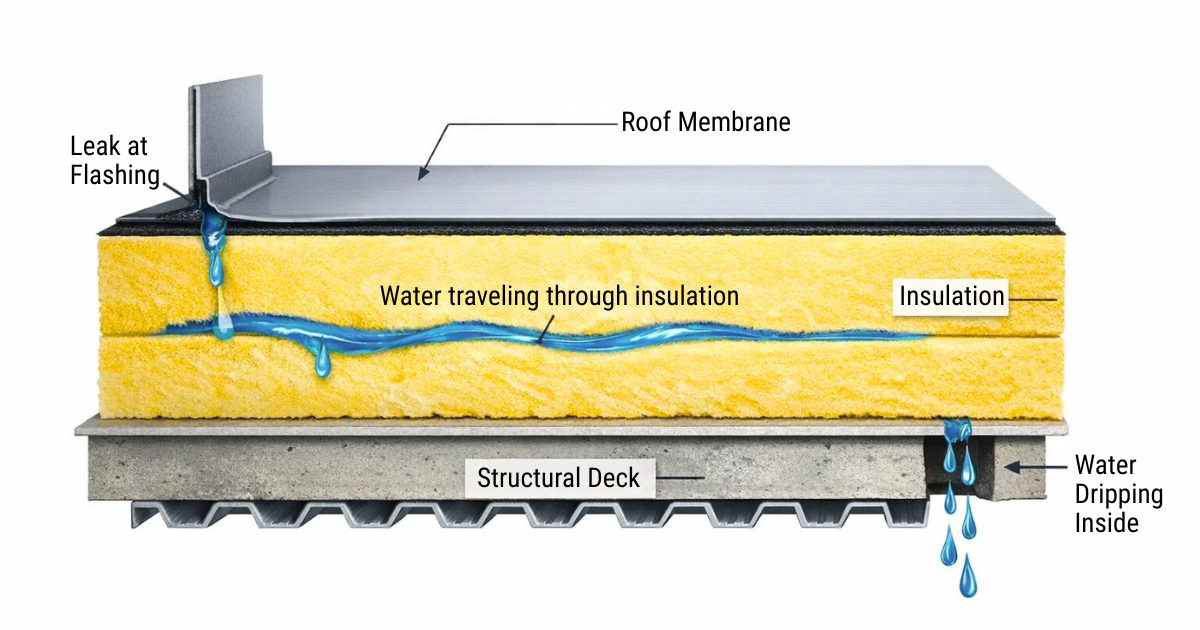
The spot where the water shows up inside your building is almost never the spot where the roof is actually failing. Water on a flat roof does not fall straight down like a polite guest. It travels. It finds the path of least resistance through the membrane, the insulation, the substrate, and the deck, and it shows up wherever it feels like it, which is usually nowhere near the actual breach.
You have been patching the wrong spot. You have been paying to patch the wrong spot. And the roof has been laughing at you the whole time.
Why Flat Roofs Are Especially Good at Deceiving You
Pitched roofs, for all their other problems, at least give you a fighting chance. Water runs downhill. You can see where the shingles are curling or missing. The damage and the entry point have some logical relationship to each other.
Flat roofs are a different animal. Commercial flat roofs, whether they are modern seamless acrylic, urethane, or vinyl (our solutions) or outdated TPO, ancient EPDM, alligator skin modified bitumen, or built-up systems, are essentially giant horizontal surfaces floating on top of insulation. When a seam opens up along a flashing or a parapet, water does not have anywhere obvious to go. It just sits there. It pools. It slowly works its way through whatever it can find. Then it travels horizontally through the insulation board, maybe six inches, maybe six feet, maybe twenty feet, before it finally finds a path down through the deck.
The ceiling stain you are looking at is the endpoint of a journey, not the origin. And the journey started somewhere your caulk gun cannot reach.
The Four Usual Suspects And Where They Are Actually Hiding
If you want to stop throwing money at the wrong part of your roof, you need to understand where flat roof failures actually come from. Spoiler: it is almost never a random hole in the middle of the field membrane. It is almost always one of these four things.
Drainage failure. Flat roofs are not actually flat. They are supposed to have a minimum slope of an eighth inch per foot to move water toward drains or scuppers. When drains get clogged, when the roof has settled unevenly over the years, or when the original installation was sloppy, you get ponding water. Ponding water is basically a slow death sentence for any membrane. It accelerates UV degradation, adds structural load, and finds every tiny weakness in every seam. A roof that ponds will leak. It is a matter of when, not if.
Flashing failures. Flashings are the metal terminations at every edge, penetration, curb, skylight, HVAC unit, and parapet on your roof. There are a lot of them. They expand and contract with temperature changes. They get hit by equipment maintenance crews who have no idea they just bent a critical seal. They age. And when they fail, they fail quietly, far from wherever the water eventually shows up inside. A flashing pulling away from a rooftop curb near the northeast corner of the building can easily be responsible for the leak showing up in the southwest conference room.
Membrane seam failure. Every commercial roofing membrane has seams where two sheets overlap and are heat-welded, chemically bonded, or taped together. These seams are the most vulnerable points on the entire roof. They require proper preparation, proper technique, and proper inspection to hold long term. On a roof that has been on the building for more than ten years, seam failures are extremely common. You cannot see them from the ground. You often cannot see them from a casual walkover. They look like nothing until they are something.
Original installation problems. Some roofs were installed incorrectly from day one. Insulation boards not properly fastened, membrane not properly primed, inadequate slope designed into the system. These problems do not announce themselves at installation. They show up five or seven years later when you are sitting in your office wondering why your maintenance budget looks like it lost a fight.
What a Real Diagnosis Actually Looks Like
Here is the thing about finding real flat roof problems, you need the right tools, not just a bucket of lap sealant and a good attitude. Legitimate commercial roofing contractors who specialize in diagnostic work use a few specific approaches that actually work.
Infrared thermography is the most effective tool for finding moisture that has already gotten into the roof system. It works like this: during the day, the sun heats the roof. Wet insulation holds heat longer than dry insulation. At night, as the roof cools down, an infrared camera picks up the areas that are still warmer than everything around them. Those warm spots are wet spots. This technology can find moisture that is sitting ten, fifteen, even twenty feet away from any visible surface damage. It turns invisible problems into maps you can actually work from.
Electronic leak detection is another approach that works well on smooth membrane roofs. It uses either a low-voltage or a high-voltage electrical current to identify breaches in the membrane. Water conducts electricity. The membrane does not. When there is a breach, the equipment finds it with a level of precision that no visual inspection can match.
A full roof condition survey goes beyond just finding the current leak. It gives you a complete picture of every area of concern on the roof, ranked by severity, with documentation. It tells you what is failing now, what is likely to fail in the next two to three years, and what is still in good shape. This is the difference between reactive crisis management and actual facility planning.
Contractors who actually show up, walk to the spot directly above your ceiling stain, probe around for five minutes, and start applying sealant are not diagnosing your roof. They are billing you to feel busy. A proper commercial roofing inspection on a building of any real size takes time, equipment, and documentation.

Before You Authorize the Next Patch
Let’s pause for a second.
If you’ve patched the same roof more than twice in the past two years, you don’t have a leak problem. You have a diagnosis problem.
You don’t need another invoice.
You need clarity.
✉️ If you want straight answers about flat roof failures, we provide that.
No fluff. No scare tactics. No “limited time offer.” Just practical guidance for commercial building owners who are tired of guessing.
[ Email address ] → [ Send Me the Real Stuff ]
The Real Cost of Doing It Wrong Repeatedly
Let's talk numbers, because this is where the logic really kicks in and the excuses stop.
A spot repair on a commercial flat roof typically runs somewhere between $500 and $2,500 depending on size and access. Sounds manageable. But if you are doing three or four of those a year on the same roof, you are spending $2,000 to $10,000 annually and making absolutely no progress. You are not extending the life of the roof. You are not reducing the risk of a major failure. You are just continuously paying for the feeling that something is being done.
Insulation traps dry air. That’s the science of how it functions. Meanwhile, every day that moisture sits inside your roof assembly, it is destroying the insulation. Wet insulation loses its R-value, which means your HVAC system is working harder than it should be. That is money leaving through your roof in a completely different way, and nobody is handing you an invoice for it so it tends to go unnoticed.
At a certain point, saturated insulation and ongoing moisture damage to the roof deck turn a recoverable roofing problem into a complete roof replacement. The cost to replace a commercial flat roof ranges from $8 to $20 per square foot installed, depending on the system and the market. On a 30,000 square foot warehouse, you are looking at $240,000 to $600,000. On a multi-story office building with a more complex roof, it is more.
A comprehensive roof survey and infrared scan on that same building might cost $3,000 to $8,000. Targeted repairs based on accurate diagnosis might run $15,000 to $40,000 and actually solve the problem for several years. The math on this is not complicated. The only reason people keep patching the wrong spot is that nobody explained it to them clearly.
What to Do Instead, A Practical Path Forward
If your flat roof has leaked more than twice in the same general area, or if you have a roof that is more than 10 years old with no formal inspection history, here is what a reasonable, non-panicked approach looks like.
First, stop authorizing emergency spot repairs as the default response. The next time someone calls you about a leak, the first call should be to a contractor who can do a real diagnostic inspection, not just a repair technician with sealant. Yes, you may need a temporary patch to stop active water infiltration while you wait. That is fine. Just do not let the temporary patch become the permanent answer.
Second, get a full roof condition survey done. Find a commercial roofing contractor who uses infrared scanning and provides a written report with photographs and moisture maps. This report becomes your planning document. It tells you the actual state of the roof, not just the area immediately above the ceiling stain you have been staring at.
Third, use the survey data to make a real decision. Sometimes the report will show that targeted repairs in two or three specific areas will buy you another seven to ten years of serviceable roof life. Sometimes it will show that the insulation is so saturated and the membrane so degraded that the roof needs to be replaced in the next 18 months. Either way, you are now working with real information instead of hope and sealant.
Fourth, (everybody thinks they have one, but how robust is yours?) … lock a genuine preventative maintenance program in place. Twice-yearly inspections, real touch-ups, drain clearing, actual membrane cleaning and conditioning, flashing checks, documentation of any equipment work done on the roof surface. Commercial roofs that are maintained properly consistently outlast roofs that are ignored and then emergency-patched. The difference in lifespan can be measured in years. The difference in replacement cost can be measured in hundreds of thousands of dollars.

A Word About the Contractors Who Keep Patching the Wrong Spot
Not every contractor who patches your roof without a proper diagnosis is doing something dishonest. Some of them genuinely believe they are helping. They see a problem, they fix what they can see, they move on. That is not fraud. That is just a limited approach to a problem that requires a more sophisticated one.
But you should also understand that there is very little financial incentive for a roofing contractor to tell you that the spot they just repaired is not actually your problem. The repair is done, the invoice is paid, and if it leaks again in three months, there is another invoice waiting. This is not conspiracy, it is just how service businesses work when nobody asks the right questions.
The right question to ask any commercial roofing contractor before authorizing a repair is this: what diagnostic work are you doing to confirm that this is the actual source of the leak, and not just the area above where the water showed up inside? If the answer is vague, or if they look at you like you just asked them to recite poetry, find a different contractor.
Here’s the Reality
Your flat roof is not leaking where you think it is leaking. The water appearing inside your building is the result, not the cause. The cause is somewhere else on that roof: a seam, a flashing, a drain that has been backing up for six months, a membrane that has been slowly deteriorating since the last administration.
Patching the spot where the water comes through is the roofing equivalent of putting a bandage on the wall next to a leaking pipe. It makes you feel like something happened. It keeps the bucket from overflowing for another season. It does not fix anything.
Get the real diagnosis. Spend the money on knowing what is actually wrong. Then fix what is actually wrong. This is not a complicated philosophy. It is just one that the roofing industry has done a poor job of communicating, and that building owners have done a poor job of demanding.
The bucket in your accounting department deserves better. So does your capital budget.
Stop Guessing, Start Knowing
If you’ve read this far, you already know the truth.
The leak isn’t random.
The roof isn’t “just old.”
And the stain on your ceiling isn’t the real problem.
What’s expensive isn’t the repair.
What’s expensive is repeating the wrong repair.
📧 If you haven’t had a data-revealing roof inspection within the last 12 months, you’re making decisions based on gaps.
“Sure, send a guy out.”
Subject property address: _______________________________
[ Email address ] → [ Yes, Send Me More ]
We’ll send you more content like this. Real talk. Slightly entertaining. Plain language. Less confusion.
We Love Conversations
 SoHelpful@PristineIndustrialRoofing.com